Define topics
Markets, competitors and keywords are set together.

The Market Signal Agent monitors defined sources and reports changes based on set criteria, with source and timestamp.
In short: News, price changes, competitor moves: the information is out there – but nobody has time to search sources continuously. Important changes are only noticed when it is too late. The agent tracks the topics you define, filters by your criteria and provides a brief assessment instead of long lists. Your team decides what a signal means.
Markets, competitors and keywords are set together.
The defined sources and topics are checked at the agreed interval.
The agent classifies hits according to your set criteria.
Notable changes are briefly summarised and put into context.
The alert names the source, the time and the criterion set.
Examples from the workflow – no percentages, as only a measurement in your business can provide those.
| Situation | Today | With the solution |
|---|---|---|
| Monitoring | Only when there’s time | Defined sources are checked at the agreed interval |
| Receipt | Feeds and newsletters unread | Only relevant items reach your team |
| Timing | Movements are noticed late | Changes are reported with a timestamp |
| Assessment | Assessing every alert yourself | Alerts come with a brief assessment |
You decide which markets, competitors and terms count.
Only what meets your criteria is reported – the rest stays out.
Alerts show when a change was detected.
Short summaries instead of lists of links and raw data.
Sample images from our visual library – the interfaces shown are illustrations, not client data.



The assessment. The agent monitors, filters and classifies. Your team decides what a signal means for your business and what follows from it.
The solution prepares, sorts and hands over – your staff make decisions and grant approvals, following rules you set.
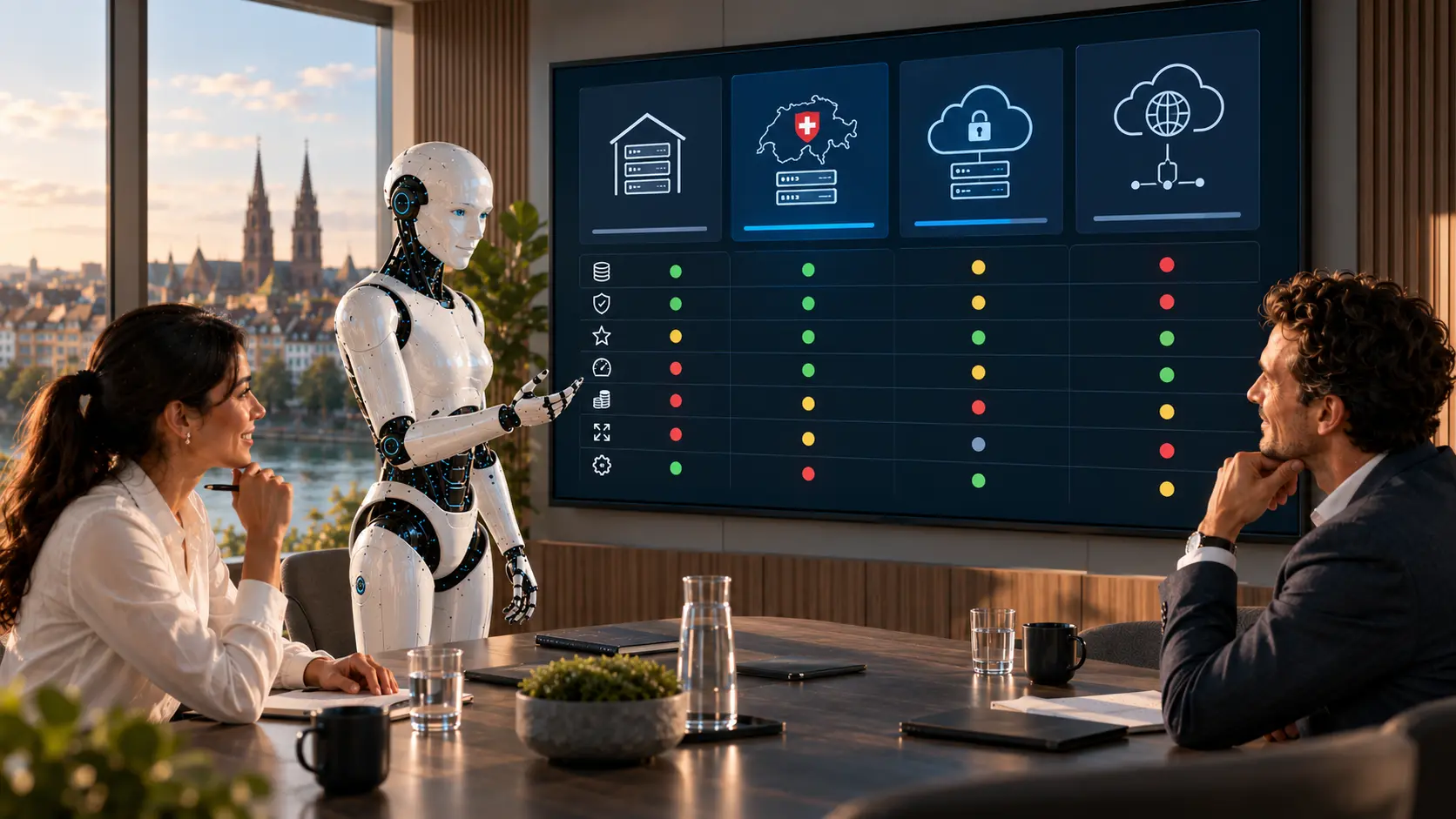
For example – what exactly gets connected depends on interfaces and permissions and is checked in the AI potential assessment.
Solution building blocks are the technical components of the Swiss AI Platform, combined by process.
Check and classify sources continuously.
View building blockMonitor, filter, report based on defined criteria.
View building blockDepending on the product and interfaces, we run the solution on your premises, in a Swiss cloud or as a combination. Before the pilot, we clarify data flows, access rights and compliance requirements. Background: Private AI and On-premise & hybrid (running on your own servers or a mix of both).
| Topic | Implementation |
|---|---|
| Data | Public and approved sources; internal data only if expressly included. |
| Approvals | Relevance criteria are defined together and can be adjusted after approval. |
| Roles & permissions | Who maintains topics, who receives alerts, who changes criteria – according to your roles. |
| Logging | Monitored sources, hits, filter decision and alert are traceable. |
| Operating model | Running on your own servers, in a private cloud or a mix – depending on the sources included. |
The pilot does not cover the whole process straight away. We pick a clearly defined part, set approvals and success criteria and test it with real data and the people who work with it. This approach is the same for every use case.
You do. Markets, competitors, keywords and relevance criteria are defined together and can be adjusted after approval.
No. It monitors, filters and classifies. Your team decides what a signal means for your business.
With an AI potential assessment. Then a small topic area is defined, monitored and only extended after clear approval.
Finance, sales and leadership teams that need to keep track of developments without constantly searching sources – manufacturing, real estate, retail.
Describe your current workflow in two sentences. We check the benefit, data situation, integration effort and risks and show whether a product, a solution building block or a custom solution makes sense.