Answer the call
Even several calls at once and outside office hours; the agent introduces itself as an AI assistant.

Calls are answered, requests identified, information captured in a structured way and passed to your staff or systems according to your rules.
In short: A voice agent takes over defined parts of first-line call handling. It captures the request, asks for the necessary information, can prepare appointments and creates a structured case. Critical or non-approved cases are handed over to people.
Even several calls at once and outside office hours; the agent introduces itself as an AI assistant.
Repair, appointment, quote, query – according to your categories.
Name, property, address, callback number and the details the case needs.
Urgency and responsibility according to the rules you set.
Match the preferred time against the calendar, create the case in the system.
Urgent matters to the person responsible, everything else as a structured task.
Examples from the workflow – no percentages, as only a measurement in your business can provide those.
| Situation | Today | With the solution |
|---|---|---|
| Call while out on a job | goes to voicemail, callback forgotten | answered, captured, assigned as a task |
| Appointment request | note on a scrap of paper in the office | suggestion in the calendar, confirmed by staff |
| Urgency | clarified on the callback | classified by rules, forwarded immediately |
| Traceability | “Who called?” | call summary in the CRM |
Calls are answered even when nobody is free.
Within the agreed scope, calls can be captured as a case with the necessary details.
Callbacks are created as tasks, not left to memory.
Who received what and when is documented.
Sample images from our visual library – the interfaces shown are illustrations, not client data.
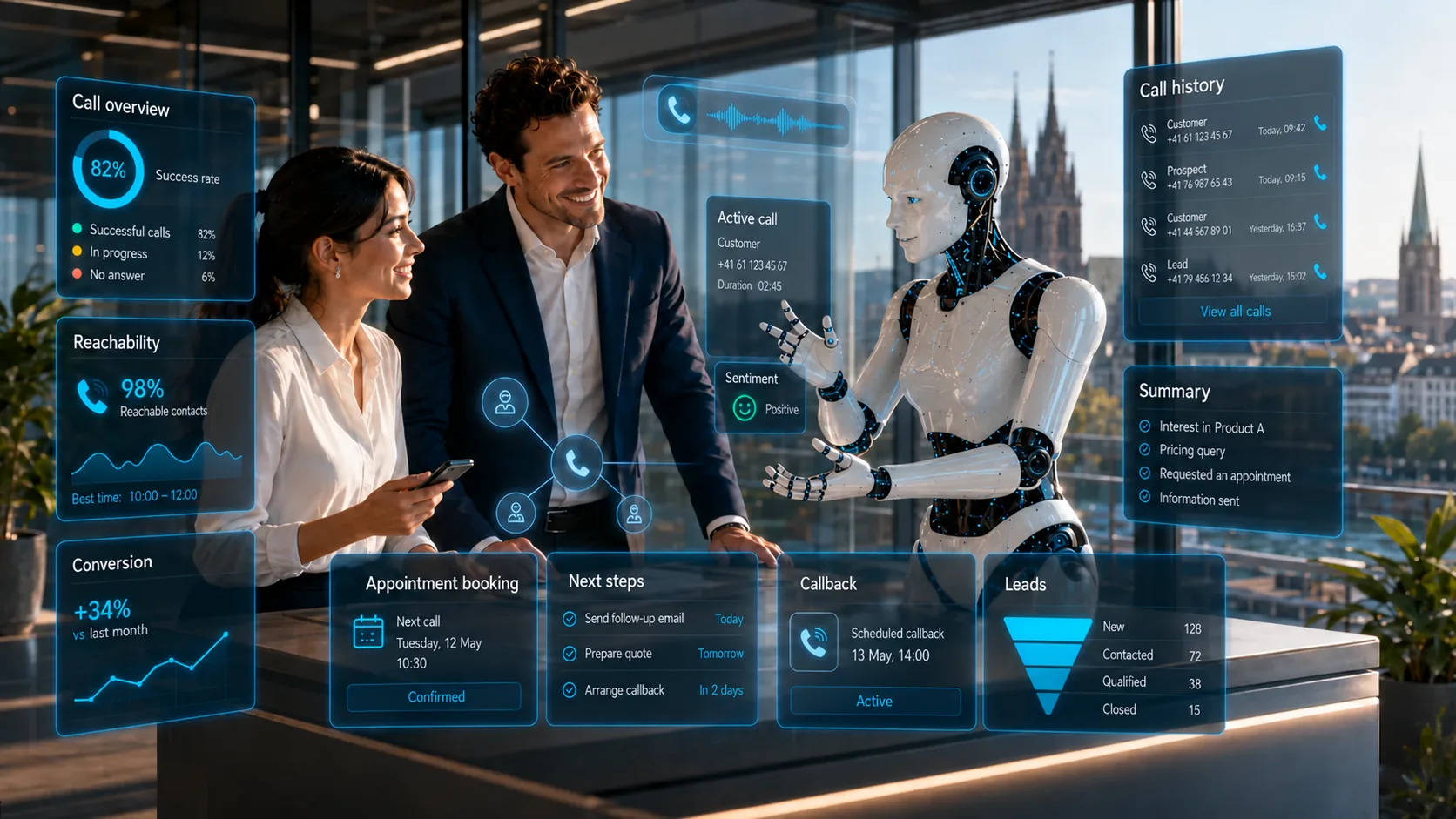
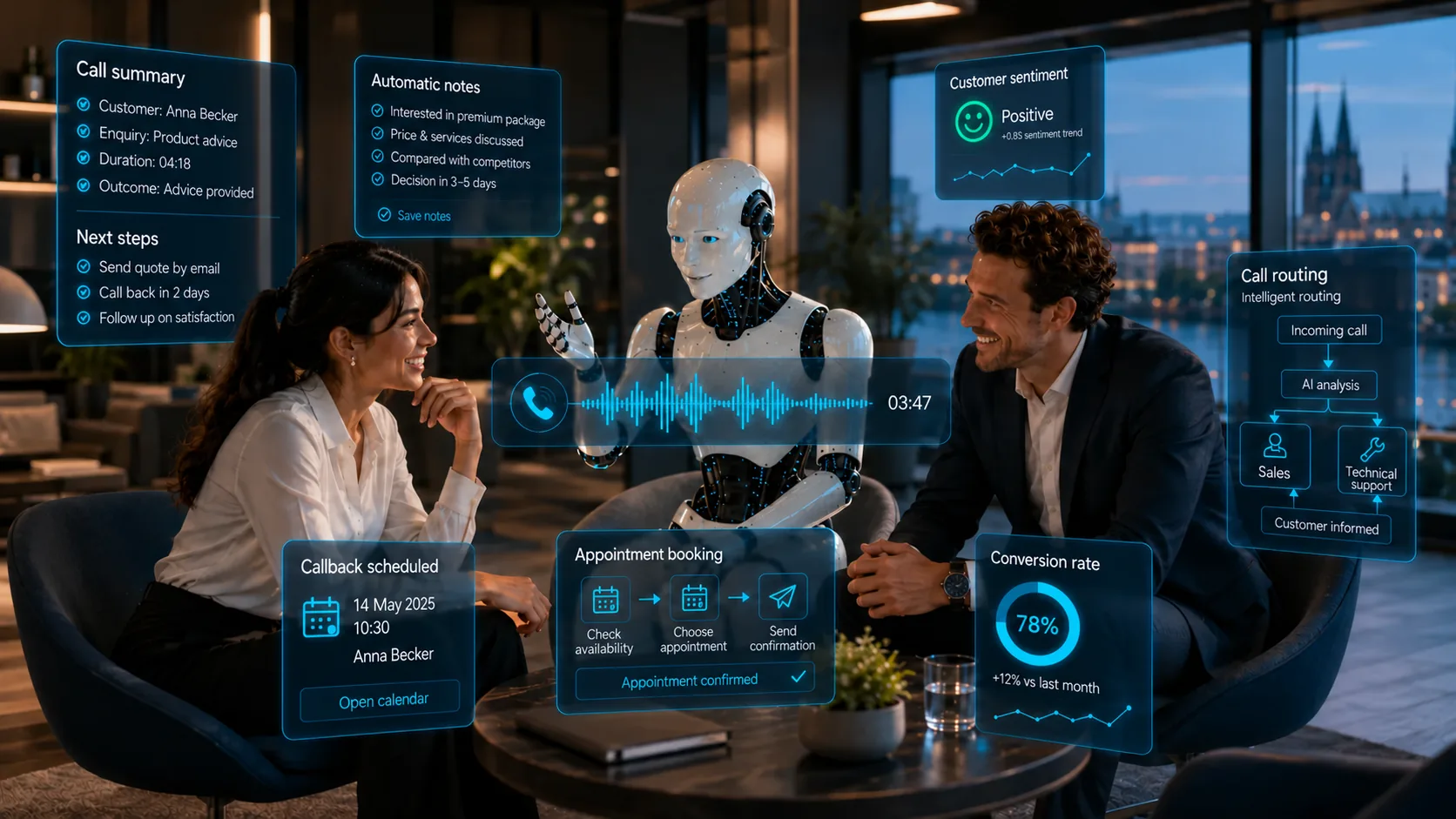

Commitments, appointment confirmations, advice and any case that doesn’t fit the defined categories. The agent captures and forwards; it does not make decisions about emergencies.
The solution prepares, sorts and hands over – your staff make decisions and grant approvals, following rules you set.

For example – what exactly gets connected depends on interfaces and permissions and is checked in the AI potential assessment.
Solution building blocks are the technical components the solution is built from. Products are only named where they fit the task.
Speech understanding, dialogue, capture.
View building blockForwarding, tasks, approvals.
View building blockHandover to calendar, CRM and ticketing system.
View building blockOur product for answering calls and structured capture.
View productDepending on the product and interfaces, we run the solution on your premises, in a Swiss cloud or as a combination. Before the pilot, we clarify data flows, access rights and compliance requirements. Background: Private AI and On-premise & hybrid (running on your own servers or a mix of both).
| Topic | Implementation |
|---|---|
| Data | Call content and contact details – confidential. |
| Approvals | Appointment confirmations, commitments and anything you don’t leave to the agent go to your staff. |
| Roles & permissions | Who sees call logs, who changes rules and forwarding. |
| Logging | Conversation, capture and forwarding are traceable for each call. |
| Operating model | Private cloud or on-premise; the connection to the phone system is checked in the project. |
The pilot does not cover the whole process straight away. We pick a clearly defined part, set approvals and success criteria and test it with real data and the people who work with it. This approach is the same for every use case.
Yes. The solution should present itself transparently as an automated, AI-powered assistant.
Speech quality and dialects must be tested in the pilot with real calls; we give no blanket quality guarantee.
No. It is not an emergency or medical decision system; callers are referred to the emergency number at the start. It only classifies urgency according to rules you set.
Businesses with many similar calls that can’t always be answered straight away in daily work – trades and building services, medical practices, administrative offices, service teams.
Describe your current workflow in two sentences. We check the benefit, data situation, integration effort and risks and show whether a product, a solution building block or a custom solution makes sense.