Computing power
GPU or CPU, sized for the models that are to run on it.

Nodes are compute nodes for models and tasks. Additional or specialised nodes can expand computing power. This may require further components, testing and adjustments.
In brief: An AI node is a compute node with models that receives tasks from Swiss AI Factory. The architecture is designed for additional or specialised nodes. How far it is expanded depends on tasks, models and load.
GPU or CPU, sized for the models that are to run on it.
A node can host one or more models – local, specialised, depending on the task.
One node for transcription, one for documents, one for knowledge search – Factory distributes the work accordingly.
On-premise, Swiss private cloud or a mix – the data class decides.
| Building block | Task | Who is responsible |
|---|---|---|
| Nodes | Run models | You / IT partner / Swiss AI Labs |
| Network | Connection between application, platform and nodes | Your IT |
| Storage | Documents, indexes, states | Your IT / private cloud |
| Backup | Recoverability of data and configuration | Your IT / private cloud |
| Access | Who may access nodes and Studio | shared |
| Operation | Monitoring, updates, support | AI Operations |
With higher usage or new tasks, an additional or specialised compute node can be planned. We test the impact on application, interfaces and operation in the project.
How many nodes a company needs depends on tasks, models and load; we size the setup in the project.
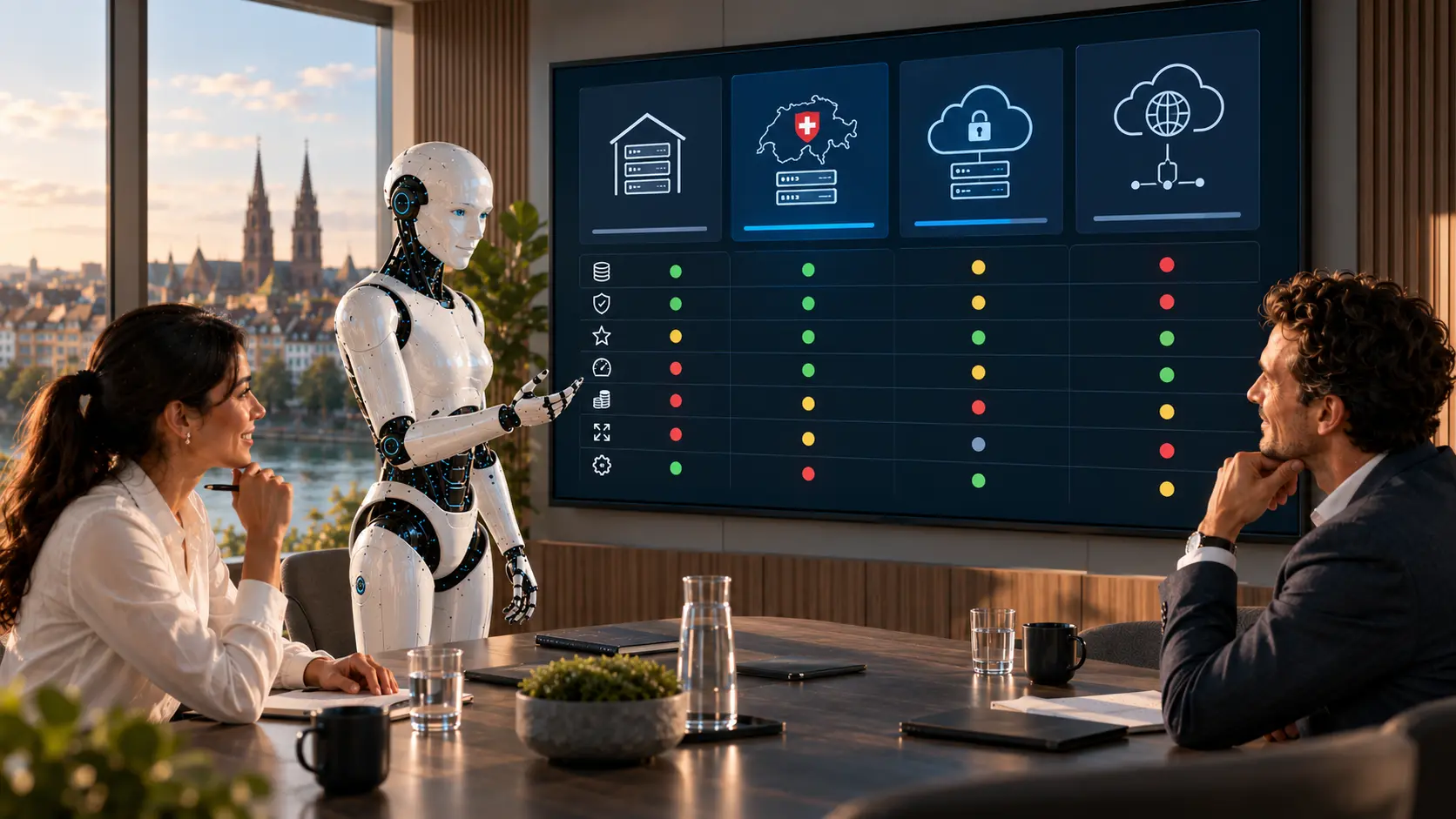
That depends on models and load. We size the setup by task – without blanket figures.
No. The number, locations and hardware of real nodes stay internal (Blueprint §16).
Publicly, we show the principle, layers and data flow at a high level. Internal topology, routing rules, security rules and version states stay internal.
We state the maturity of each building block openly. Phrases such as “is designed to” describe the architecture, not a client deployment. Studio, Agents and parts of Factory run in our own development and operating environment and are continuously extended. Further operating models, multiple nodes and private and local installations will follow step by step.
We size nodes according to tasks, models and data classes.